
Checking Criminal History in Greenville County
No single search returns every Greenville County criminal record. Begin with a full legal name and note any middle name, prior surname, alias, and date of birth that can help separate people with similar names. An exact case number is even stronger. The free Greenville Public Index is the best first stop for a filed General Sessions case, but it is a case finder rather than a statewide rap sheet. A new arrest may reach the detention system before a prosecutor files the court case. A city or magistrate matter can also remain with its own summary court.
Work from the newest local event toward the final court result, then use the state system when a broader South Carolina view is needed. Follow this order:
- Search the Greenville Public Index by full name or exact case number and select the criminal or General Sessions area.
- Check the county inmate tool when the event is recent or current custody is in question.
- Ask the arresting agency for its incident report and Public Safety Records for a booking record.
- Read each filed charge and disposition. A status line alone does not prove how a charge ended.
- Order a certified court copy or a SLED report when an official source record is needed.
This sequence reduces false conclusions. A no-result screen only describes that one system at that point in time. It does not prove that no arrest, warrant, court case, state sentence, or federal record exists.
Greenville County Criminal Index Fields
The county index requires acceptance of its disclaimer and uses separate search controls for court area, case number, and party name. Greenville County code 23 appears inside General Sessions identifiers. A typical number follows YYYYGS23#####, while a transferred summary matter may use YYYYA23########. Cookies and JavaScript must work, and a blocked pop-up can hide the detail screen. Automated repetitive searches are barred.
| Search field | Use | What to know |
|---|---|---|
| Case number | Exact case search | Use the full General Sessions or summary format. |
| Last name | Party search | Required for a name-led search. |
| First and middle names | Narrowing | Useful for common names and aliases. |
| Filed-date range | Time filter | Shown where the chosen search mode supports it. |
The index generally reaches online General Sessions entries from 1984 forward. Older Greenville County criminal files need clerk help, and document images are not usually posted. The screen points to the file; it is not the certified file itself.
South Carolina Official Background Checks
The SLED Citizens Access to Criminal Histories, or SLED CATCH, is South Carolina's public name-based repository product. It uses first name, last name, and date of birth with starts-with matching. A Social Security number is optional and is searched when supplied. The standard report costs $25. The live notice set a $1.43 online service fee effective July 1, 2026, although older portal text still mentions $1. Check the payment screen before submitting.
The official CATCH terms page states the product's reach and limits before a Greenville County criminal record search begins.
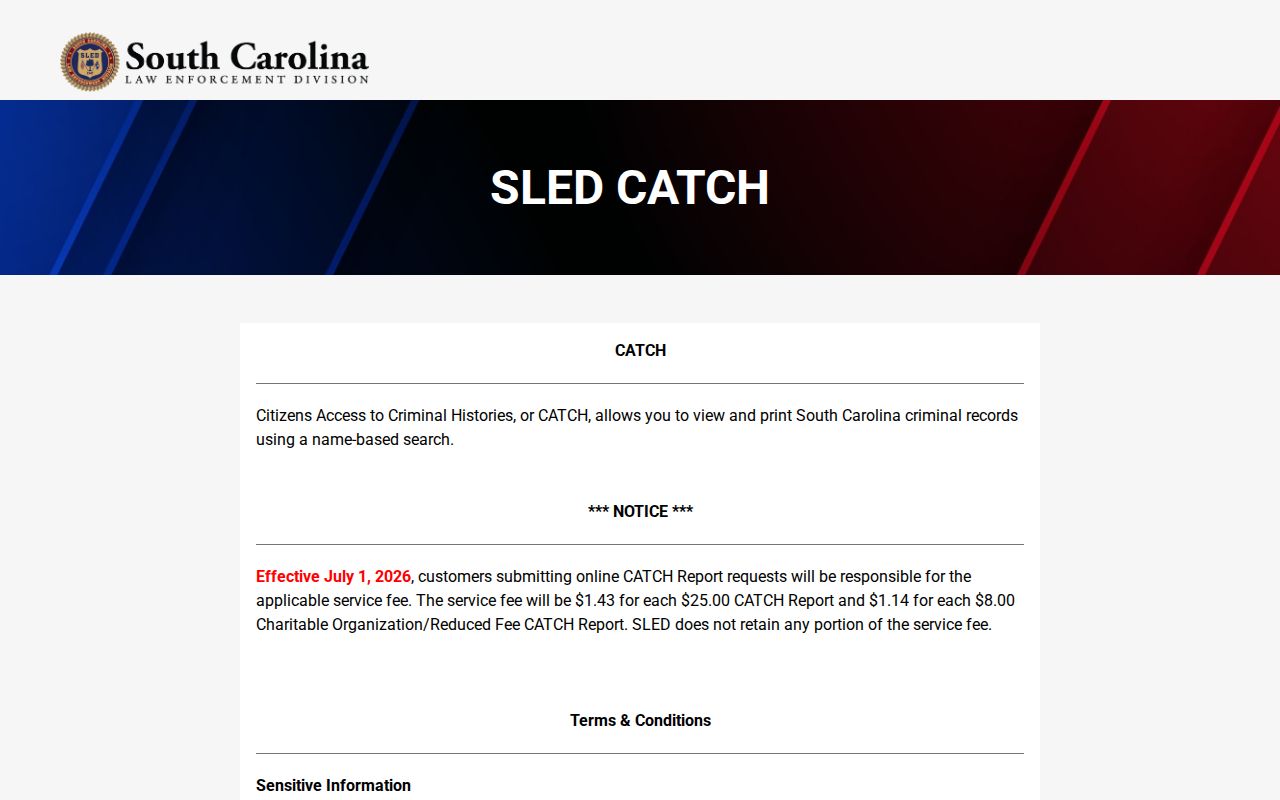
The notice matters because CATCH covers South Carolina history only. It excludes wanted-person data and sex-offender results, and a name match is less reliable than fingerprints.
Mail is another official route. Send the SLED form, a $25 business check, certified check, cashier's check, or money order, and a self-addressed stamped envelope to SLED Records Department, PO Box 21398, Columbia, SC 29221-1398. Cash and personal checks are not accepted. Ask for notarized or certified output in writing if needed. Fingerprint checks are available only for processes authorized by law; local law enforcement or IdentoGO Print and Go can make fingerprint cards for the receiving agency. A person reviewing their own national record should instead use the FBI Identity History Summary process. The CATCH user-type screen shows the official choice between an account login and guest access.
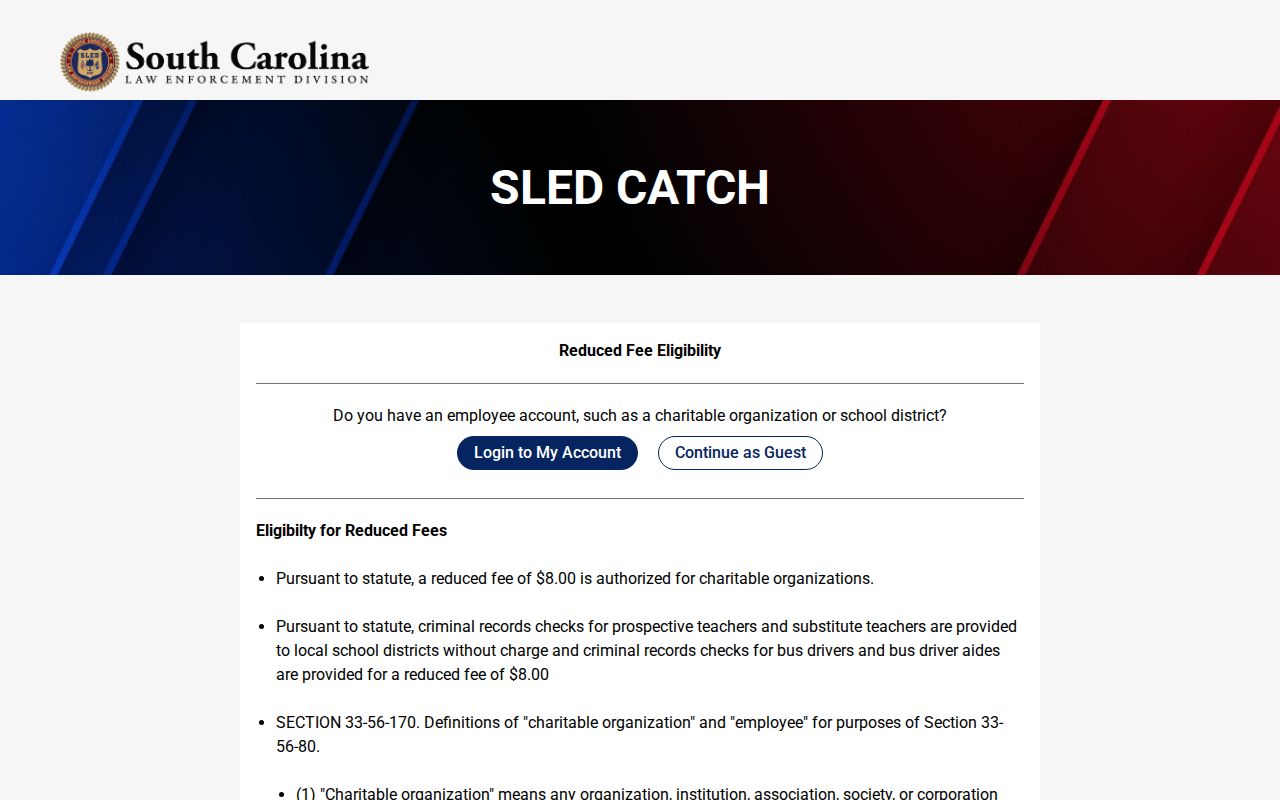
A guest may run one Greenville County criminal history query without creating an account, but must still accept the terms and provide the required match data.
Two Greenville County Records Counters
Greenville County criminal record requests split between two main counters. The Clerk of Court Criminal Records Department in Suite 228 at 305 E. North Street keeps public General Sessions documents. It supplies warrants, indictments, sentence sheets, bond papers, plain copies, and certifications. The counter is open weekdays from 8:30 a.m. to 5 p.m.; call 864-467-8745 or email coccriminalrecords@greenvillecounty.org. Staff advises waiting two to three business days after adjudication before asking for an updated file.
The Clerk of Court's official page provides the source view of the Greenville County courthouse and its services.
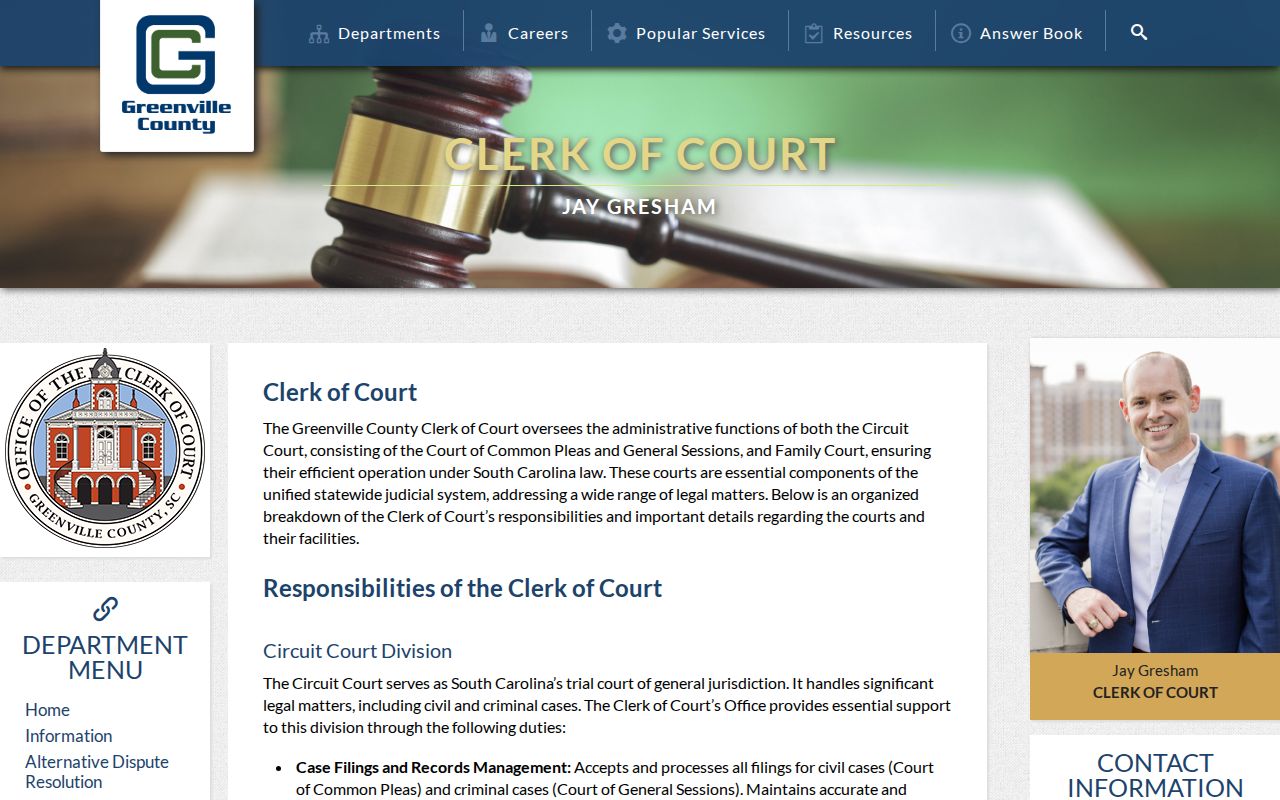
The courthouse image connects the online index to the physical file counter that can issue certified copies.
Public Safety Records at 4 McGee Street is the other hub. It centralizes Greenville County Sheriff's Office, Greenville Police Department, and detention materials, including incident reports, booking records, and local background products. The records line is 864-467-5278, and the weekday counter hours are 8:30 a.m. to 5 p.m. Municipal police agencies outside Greenville city may keep their own incident files, so the arresting agency still controls the first report.
Criminal Records Department
305 E. North St., Suite 228
Greenville, SC 29601
864-467-8745
Weekdays, 8:30 a.m. to 5 p.m.
Public Safety Records
4 McGee St.
Greenville, SC 29601
864-467-5278
Weekdays, 8:30 a.m. to 5 p.m.
Criminal Record Types
Each Greenville County criminal record answers a different question. An arresting agency writes the incident report. Detention staff create a booking entry. A magistrate or municipal judge handles warrants and the first bond stage. The Solicitor decides what charge to pursue, and the Clerk of Court keeps the filed General Sessions case. SLED then builds state history cycles from fingerprints, charge reports, and later dispositions.
- Incident and arrest report: the agency narrative, officers, location, and reported facts, with lawful redactions.
- Booking record: intake, current charges, bond, agency, and custody data that do not prove guilt.
- Court case file: filed charges, docket events, pleas, disposition, and sentence.
- Warrant and bond file: court process, warrant or ticket number, conditions, holds, and judicial action.
- State history: SLED's fingerprint-supported arrest and disposition cycles across South Carolina.
- Custody or supervision record: county jail, SCDC prison, federal prison, probation, or parole information held in separate systems.
South Carolina grades classified felonies from Class A through F, with maximum prison terms that step from thirty years to five years. Classified misdemeanors run from Class A through C, with maximum terms of three, two, and one year. Some offenses are unclassified, and the offense statute controls any fine. Venue is not set by the word misdemeanor alone. General Sessions may hear a misdemeanor, while a magistrate or municipal court hears only matters within its legal reach.
For a closer path from booking allegations to later case outcomes, use the Greenville County arrest lookup. The South Carolina Sex Offender Registry is also separate from CATCH. Its profiles and lawful-use rules are covered through the Greenville County sex offender search. Juvenile, medical, victim, sealed, and expunged records follow stricter access limits.
Greenville County Criminal Custody Layers
County jail, state prison, and federal custody tools cannot be swapped. Greenville County's inmate search is for the detention center, where many people are awaiting court. A result may show custody confirmation, charge rows, warrant or ticket numbers, case numbers, arresting agency, judge, bond, sentence, or an outside hold. Housing, account balance, and release-date detail are not public online. The detention center at 20 McGee Street handles those questions at 864-467-2309.
The SCDC Incarcerated Inmate Search is the official state-prison source for sentenced South Carolina custody.
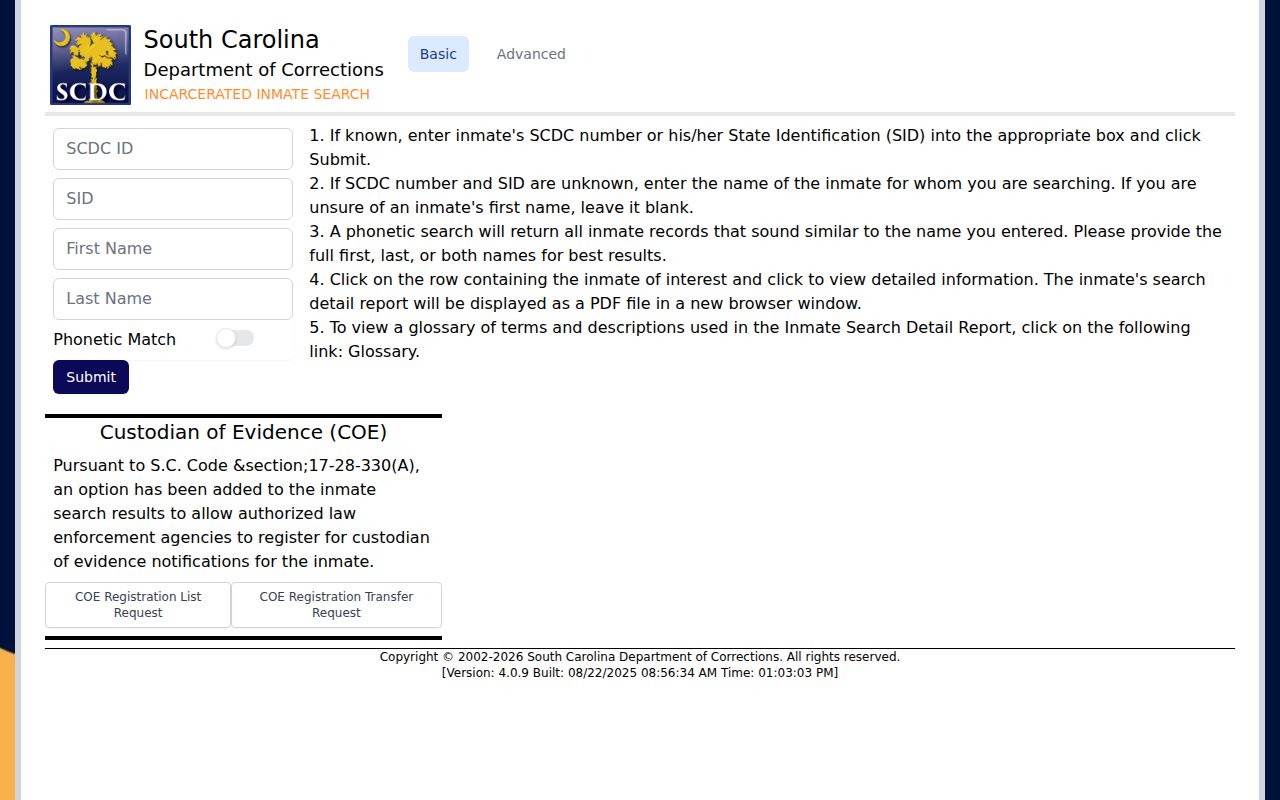
The SCDC screen covers a different population from Greenville County's jail tool, while the federal Bureau of Prisons locator supplies a third custody layer.
The Greenville County detention complex has three buildings with a combined rated capacity of 1,277 beds. Building Two dates to 1976, Building One opened in 1994, and Building Four opened in 2007. Current custody data can change fast. A blank result may mean release, transfer, a spelling mismatch, or custody in another system, not the absence of criminal history.
Inside a Greenville County Criminal Record
A Greenville County criminal record changes shape by custodian. SLED organizes identity details and arrest cycles. The Public Index organizes one court case. The jail organizes one detention admission. Matching these formats requires reading field labels closely and tracing each charge to an outcome.
| Name & Identifiers | Legal name, aliases, birth data, sex, race, state ID, FBI number when present, and fingerprint identifiers in the repository file. |
|---|---|
| Arrest / Booking Data | Arrest date and agency, booking entry, charge rows, warrant or ticket numbers, bond, and current custody. |
| Charges & Statutes | The alleged offense at intake and the charge later filed by the prosecutor, which may not be the same. |
| Disposition | Pending, dismissal, nolle prosequi, acquittal, or conviction, read for each charge rather than inferred from case status. |
| Sentence | Confinement, probation, fines, restitution, or other court-ordered terms shown in the filed case. |
| Custody / Supervision | County detention, state prison, probation, parole, or revocation data held by the responsible office. |
Since January 1, 2026, home addresses no longer display in Greenville County Public Index cases. Full dates of birth and sensitive personal numbers are also absent from the public view. A certified source document from the clerk remains the sound choice when the exact wording of an order matters.
Greenville County Warrant Record Chain
Greenville County has no official public name-based list that covers all active warrants. Confirm a suspected warrant with the office that holds it. GCSO Warrant Services keeps originals and answers at 864-467-5241. Time-sensitive after-hours information goes through 864-271-5210, option 8. A municipal or magistrate court may hold its own bench warrant, while an SCDPPPS Most Wanted entry concerns supervision absconders only.
Use a careful chain: verify the name and case with Warrant Services, identify the issuing court, obtain the bond or appearance instructions, and address the court named in the file. Do not treat absence from the jail roster as clearance. Public Safety Records can provide added warrant or case information at $3 per five charges, and court-issued bench-warrant material may be available from the issuing summary court or the General Sessions clerk.
Property surety bonds are handled on weekdays from 10 a.m. to 4 p.m. at Law Enforcement Center Room 116A, 864-467-5315. After hours, contact the detention center bond-court side at 864-467-2402. The clerk filing charge is $10 and photo identification is required.
Public Access Laws in South Carolina
The South Carolina Freedom of Information Act provides access to nonexempt records, but it does not make every criminal record open without limits. Greenville County may charge reasonable search, redaction, and copy costs and may seek a deposit. Active-investigation material, juvenile files, protected victim data, medical records, sealed cases, and personal identifiers can be withheld or redacted. Ask the office that created or holds the exact record.
Key statutes:
S.C. Code §30-4-30 sets access, response, production, fee, and deposit rules for nonexempt public records.
S.C. Code §§23-3-115 and 23-3-120 govern SLED dissemination and the fingerprint reporting that builds state history.
S.C. Code §17-1-40 requires destruction of eligible arrest and booking records after specified nonconviction outcomes.
S.C. Code §23-3-490 supports public registry access and penalties when registry data facilitates a crime.
Public access does not turn an arrest into a conviction. Nor does a public name match establish identity on its own. Compare birth information where lawfully shown, review aliases, and confirm the result with the originating Greenville County office.
Greenville County Criminal Records by FOIA
A records request fills gaps when a portal does not show the source document. Greenville County Public Safety requests may be emailed to publicrecords@greenvillecounty.org or GCDPSFOIA@greenvillecounty.org, or delivered to 4 McGee Street. Describe the agency, date span, incident or case number, people involved, and the precise document. Ask for electronic delivery and a cost estimate when practical.
The official Public Safety FOIA page links the form and submission route for Greenville County criminal records.
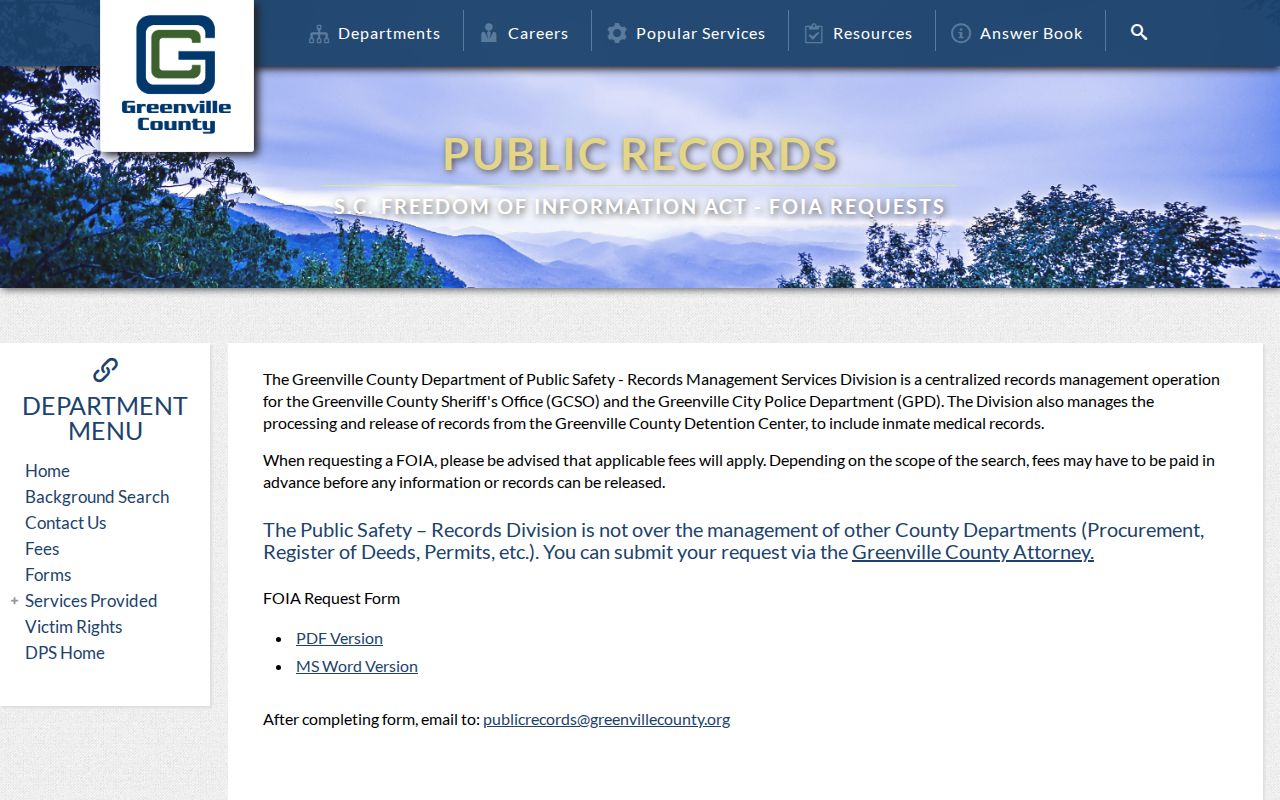
The form requests the request date, name, mailing address, phone, signature, and a specific description; staff fields track receipt and response.
For material no more than 24 months old, the county has ten business days to decide whether the record is available. Older material allows twenty business days. That is a decision deadline, not a promise of production. After any required deposit, the published schedule allows thirty calendar days for newer material and thirty-five for older material. A deposit can be up to 25 percent.
| Product | Published cost |
|---|---|
| General Sessions plain copy | $0.25 per page |
| General Sessions certification | $10 per certification |
| County letter-size black-and-white copy | $0.10 per page benchmark |
| County search, retrieval, and redaction | About $20 per hour; request a quote |
| County electronic media | $5 for CD or flash drive |
Sealed, Expunged, and Restricted Records
Greenville County expungement begins with the office tied to the outcome. General Sessions applications route through the Thirteenth Circuit Solicitor's PTI Office at 350 Halton Road, Suite 301. Applicants should bring current photo identification and the final disposition for every charge. A dismissed or not-guilty magistrate or municipal matter goes directly to that summary court. Eligibility depends on the charge, outcome, prior history, waiting period, and program, so the Solicitor does not give eligibility opinions by phone.
The standard fee stack, when applicable, is $250 for the Solicitor, $35 for the Clerk, and $25 for SLED. Some routes use only part of that stack. General Sessions relief for a qualifying nonconviction under §17-1-40 can be free unless the dismissal or nolle prosequi was part of a plea bargain involving guilt or sentence on another charge. Fees are paid by nonrefundable money order or attorney check.
Expungement removes or destroys eligible government criminal records under statute. It does not erase news archives, social posts, or private copies. SLED retains a narrow nonpublic entry to prevent repeat use of once-only relief. A pardon is a separate executive remedy. If a cleared Greenville County record still appears, obtain the certified order and disposition, ask the source office to correct its data, then ask SLED to update the state cycle.
Greenville County Criminal Reporting Chain
Fingerprinting explains why the county and state views can disagree for a time. The arresting agency first creates its report. Detention staff add the booking record, fingerprints, photograph, and charges. South Carolina law requires qualifying prints and charge data to move to SLED. A judge handles the first warrant and bond stage, the Solicitor decides what to prosecute, and the Clerk records the filed case and disposition.
Record flow: Arresting agency → Greenville County Detention Center → bond or summary court → Thirteenth Circuit Solicitor → General Sessions Clerk → SLED criminal-history cycle.
The state product is only as complete as its source reports. Aliases, changed birth data, and a disposition that has not yet reached SLED can break a name match or leave a cycle open. SLED states that fingerprints are the most reliable way to establish identity. When a Greenville County criminal record is wrong, correction starts at the office that made the wrong entry, not at the last portal where it appeared.
- Disposition
- The court's outcome for a charge or case.
- Nolle prosequi
- The prosecutor ended that charge without a trial judgment at that time.
- Dismissal
- A charge ended without a conviction for the reason stated in the order.
- Docket
- The chronological court record of filings and events.
Greenville County Supervision Records
Probation and parole are state-run in South Carolina. The court docket states the sentence and holds revocation filings. SCDPPPS keeps the active supervision layer. Its search accepts first and last name, a state identification number, year of birth, and county in supported combinations. Results reflect the prior day's data, so the Greenville office at 350 Halton Road, Suite 100, 864-282-4540 is the same-day confirmation source.
The official SCDPPPS site identifies the agency that manages probation, parole, pardon work, and its offender-search channel.
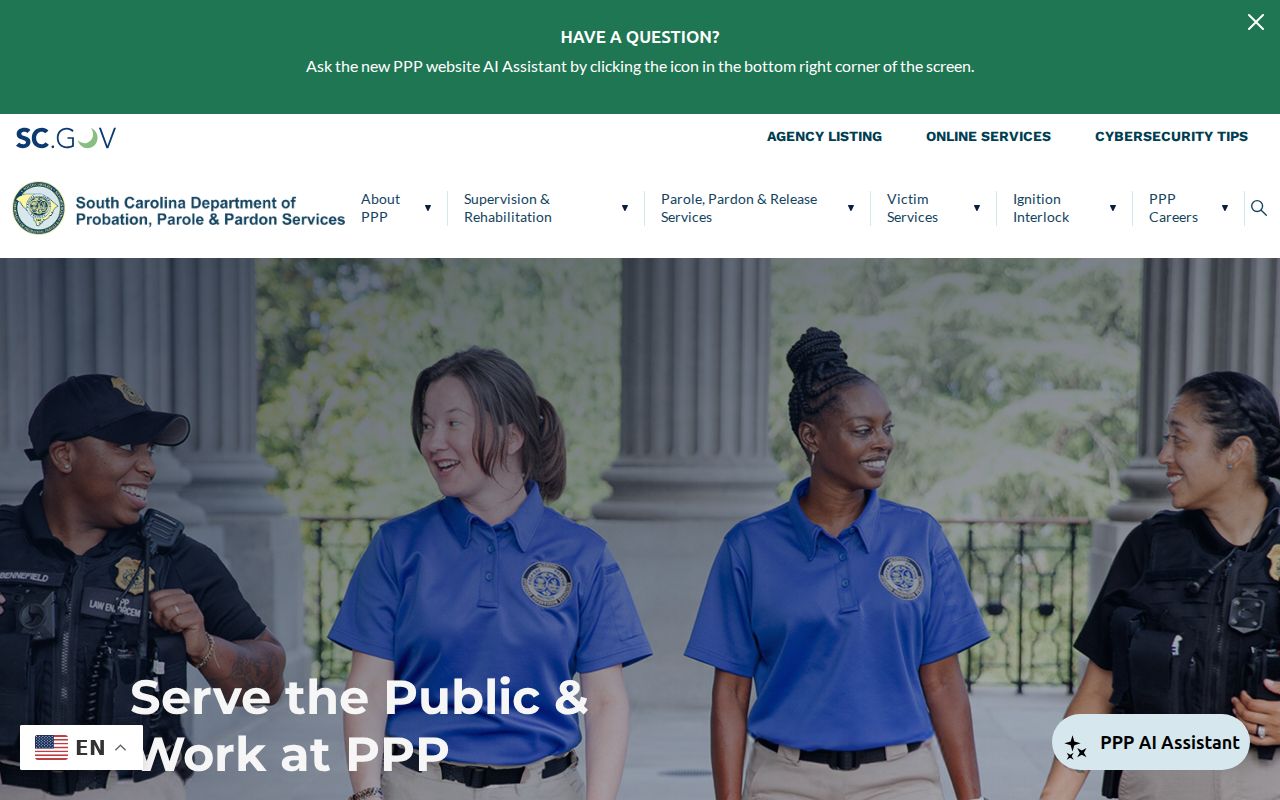
The SCDPPPS view should be read as a recent supervision snapshot, while the Greenville County criminal case remains the source for the imposed sentence.
Probation is community supervision ordered by a judge. Parole is conditional release from a prison term under the state board. Officer notes, treatment information, and risk data are not the same as a public court docket. An SCDPPPS Most Wanted result is limited to supervision absconders and is not a countywide warrant list.
Greenville County Criminal Records by City
City police departments create their own incident and arrest narratives, and municipal courts keep cases within their jurisdiction. Greenville routes police reports through centralized Public Safety and city FOIA channels. Greer has its own records counter and spans Greenville and Spartanburg counties. Simpsonville uses its police records desk and the South Greenville Summary Court location. Begin with the city that made the record, then trace any booking to the county detention center and any higher charge to the proper circuit court.
Greenville Criminal Records
Population 75,310 · city police records and Municipal Court at 204 Halton Road
Greer Criminal Records
Population 50,007 · a city records system that crosses two counties
Simpsonville Criminal Records
Population 28,459 · city police records and South Greenville court routing
Greenville County Criminal Records Before 1984
The online boundary does not mark the start of Greenville County criminal records. It marks the practical start of the current General Sessions index. The county's courthouse line began with an 1822 building at Court Square, followed by an 1855 Gothic courthouse whose courtroom held about 500 people. A 1917 Beaux-Arts courthouse survived the move to the current 1949 building, and the Judicial Wing added in 1997 now serves as the main entrance.
That long paper history is why an old case may require clerk research or an off-site file request. Start with Suite 228 and give staff the fullest known name, approximate year, court, and charge. Older material may take a couple of business days to retrieve. Do not treat an empty online result as proof that no historic Greenville County case exists.
Three Greenville County Criminal Records
A booking entry, a court file, and a CATCH report can all refer to the same event yet say different things. The booking entry captures allegations and custody at intake. The court file shows what prosecutors filed and how each charge moved. CATCH assembles a statewide cycle from fingerprint and disposition reporting. Timing alone may place an event in one system before it reaches another.
The safest rule is simple: use the jail for present custody and bond, the clerk for filed charges and the final court order, and SLED for the statewide repository view. Use the incident-report custodian for the narrative. If the sources conflict, ask each office to correct its own record and keep the certified proof of the right result.